Decay Chains
A radioactive decay chain is a tree whose depth is not a design choice. U-238 takes fourteen steps to reach lead; tritium takes one. Bismuth-212 genuinely forks — beta-minus 64% of the time, alpha the other 36% — and the two branches rejoin at Pb-208. So the glyph nests as deeply as the physics does, and comparing two glyphs compares two nuclear histories.
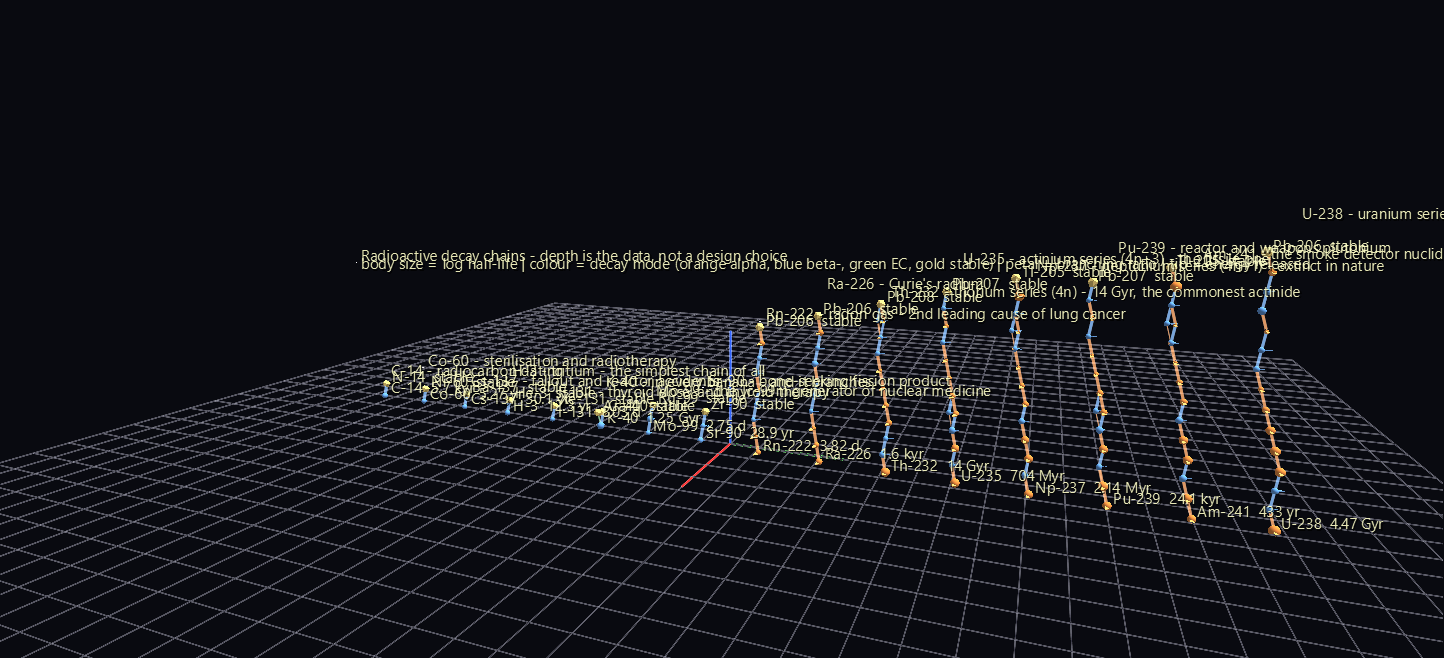
Try it: download this example below (or the full examples set), then open Decay_Chain_Example/Chain_Forest/chain_forest_gv_node.csv — or drag its folder onto the window.
Chain_Forest (9 KB) Secular_Equilibrium (13 KB)
The two scenes
Chain_Forest/ — sixteen chains side by side, ordered by how many decay steps they take, so the forest reads as a skyline. On the left the one-step chains: C-14, Co-60, Cs-137, tritium, I-131, K-40, Mo-99, Sr-90, each with its gold stable endpoint immediately above. On the right the four natural series towering fourteen levels up. The variation is the finding.
Secular_Equilibrium/ — the four natural series animated across thirteen decades of logarithmic time, every member's activity solved from the Bateman equations. Watch equilibrium fill a chain from the top down: fast daughters almost at once, Th-230 and Pa-231 taking a hundred thousand years. A cursor rides a log-time axis from 2.78 hours to 317 million years.
Structure
chain member hub          invisible frame, ALWAYS scale 1
├─ body                   sphere sized by log half-life, coloured by decay mode
├─ activity sphere        animated by the Bateman solution (Secular_Equilibrium)
├─ ring                   topo = Cylinder
│   └─ mode petal ×1-3    azimuth = which mode, length = branching ratio
│       └─ tip            cone sized by the energy released (Q value)
└─ daughter hub           ... and the chain descends from here
Sixteen levels deep at the deepest point. That's only possible because chain hubs are always scale 1: a parent's scale multiplies its whole subtree, so encoding half-life as the hub's own size would compound fourteen times over and collapse the chain. Half-life lives on a child of the hub instead, where it's a leaf and can't propagate.
Horizontal offsets are the real chart-of-nuclides displacement — an alpha step moves −2 protons and −2 neutrons, a beta-minus step +1 and −1 — while each decay step rises by a fixed height. A chain glyph is therefore a spiral staircase whose shadow on the ground is the familiar zigzag of the chart of nuclides, and whose alternating orange and blue rungs are the alpha/beta alternation defining the classical series.
Every decay edge is drawn as a Link node, including edges outside the spanning tree. A chain is a DAG, not a tree — a node can only have one parent_id — so each nuclide attaches to the first parent that reaches it and the rest are links, which is how Bi-212's fork stays visible.
What the physics says
The four classical series come out with the right members and endpoints, staying in their own 4n+k mass-number families. One nice detail: the neptunium series ends on Tl-205, not Bi-209. The textbooks stop at bismuth-209, but Bi-209 was measured alpha-unstable in 2003 with a half-life of 2.01×10¹⁹ years, so a current nuclear-data table carries the series one step further.
Two problems worth recording
Floats cannot solve this. Decay constants in one chain span 25 orders of magnitude (Po-214 at 4.2×10³ /s, U-238 at 4.9×10⁻¹⁸ /s). The Bateman solution is an alternating series whose individual terms are astronomically larger than their total, so in float64 it's pure cancellation noise. The solver runs in stdlib decimal at 120 digits — exact for these chain lengths, and no new dependency.
The published branching ratios do not close. Verifying atom conservation turned up a residual far too large for 120-digit arithmetic, and the cause was the input data: each decay mode's percentage is rounded independently in the evaluated nuclear data, so Bi-214 sums to 100.003%, Tl-210 to 100.007%. Left alone, the solution quietly creates atoms at the 10⁻⁵ level. Branch fractions are now renormalised per nuclide, and conservation comes out at 2.7×10⁻¹⁰ — which is exactly U-238's spontaneous-fission branch, a mode with no single daughter to follow.
Branches below 0.5% are pruned for legibility, which discards the famous astatine path; the verifier checks conservation on both the pruned and unpruned chain so the cost is measured rather than assumed.
Data
IAEA Nuclear Data Services ground_states export (NUBASE/ENSDF-derived), 3,386 ground states, vendored in the example. No network needed to rebuild.