
EdTec671 - Learning Environment Design
Project 2: Informal Learning Environment
Module 1: Casing an Informal Learning Environment
The informal learning environment I chose to case was the Castle Park High School Biodiesel Exhibit at the 2013 Greater San Diego Science Festival. I participate in the festival myself as part of the San Diego Supercomputer Center Education group. The Castle Park High School Biodiesel exhibit was actually adjacent to ours.
This exhibit was attracting significant attention. It was run entirely by high school students. Most students wore bright red t-shirts providing a clear sense of team spirit. This exhibit was somewhat unique in that it used a linear “assembly-line” approach towards educating their audience. Participants would get in line and step one-by-one through each of several stations each with a student demonstrating their particular part of a multi-step biodiesel synthesis process. Most other exhibits at the festival allow participants to simply walk up to any spot at the exhibit table(s) and have some interactive experience for an arbitrary length of time.
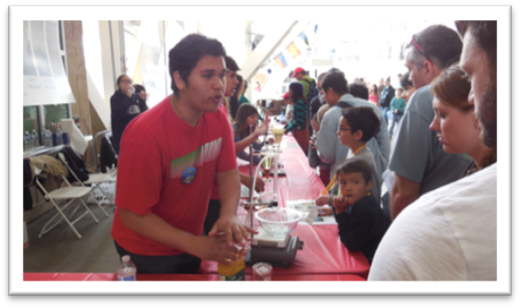
Castle Park High School Student Raymond introduces Science Festival participants to the first step in the biodiesel synthesis process.
Participants are expected to learn how biodiesel is made and how it is a more sustainable source of fuel than petroleum. Participants learned about the biodiesel fuel synthesis process by listening to the students explain while they perform demonstrations of their particular part of the biodiesel fuel synthesis process in addition to observing graphical diagrams.
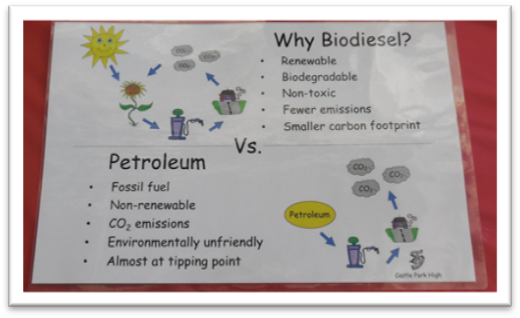
Diagrams such as the one shown above were used to help participants understand the cyclical nature of carbon processing with biodiesel fuel in contrast with the uni-directional process with petroleum.
The number and enthusiasm of the students seemed to be the dominant attraction. The topic is relevant, there were large eye-catching posters in the background, and the demonstrations were interesting and well-presented. They also had “barkers” in the aisle trying to attract participants to their exhibit.
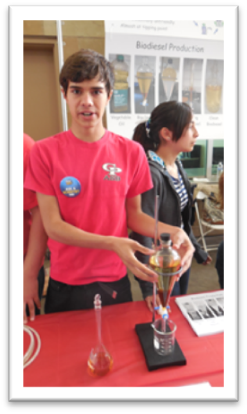
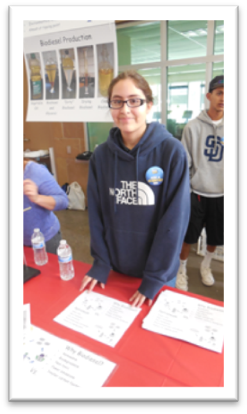
Castle Park High School students Mark and Emily explain and demonstrate various steps in the biodiesel synthesis process.
Perhaps the first and primary visually-engaging features of the exhibit were the red tablecloths with the chemistry lab equipment so familiar to so many Science Festival participants with a student in a red t-shirt at each station.
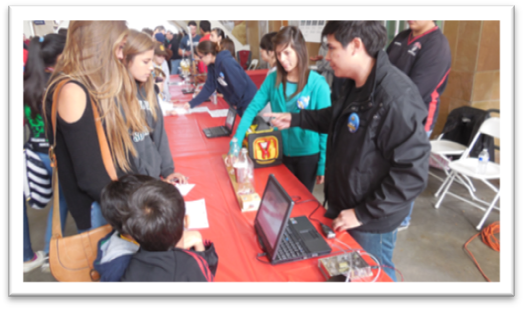
Some participants felt ‘stuck in line’ but did not want to be rude and leave before the end of the series of demonstrations. Still, most participants seemed to be very interested in the demonstrations. Some expressed disappointment the exhibit did not actually give them anything to take with them. Most festival exhibits have ‘freebees’.
Some participants were not familiar with how biodiesel is made, some thought you could simply put cooking oil straight into a diesel engine and were surprised to learn this was in fact not the case. Some participants expressed a sort of ‘aha’ moment when they realized the carbon in biodiesel comes from plants which themselves use carbon from the atmosphere creating a very sustainable cycle, unlike diesel from fossil fuel. Knowing firsthand how difficult “booth-duty” can be, I was particularly impressed by these students’ ability to give virtually nonstop demonstrations for nearly 6 hours.
IMLS Guidelines for Project Outcomes
Here is a brief summary of the IMLS guidelines as they pertain to the case study above.
Knowledge
Learners will learn specific details about how biodiesel is created.
Learners will acquire an awareness of how biodiesel is a sustainable resource and how it is different from fossil fuel in this way
Skill
Learners will develop consumer decision-making skills based on their newly-acquired awareness of the benefits to the environment of using biodiesel fuel over petroleum-based fuel.
Attitude
Learners will acquire more positive attitudes towards biodiesel and a more realistic attitude towards fossil fuel as an unsustainable resource.
Behavior
Learners' purchasing habits will become more supportive of technologies that use biodiesel.
Status
Learners' status may be positively affected within circles of friends, family, and colleagues with their newly-acquired knowledge.
Life Condition
Learners' are mostly science-oriented and their life condition may be impacted in how their career goals change to support biodiesel.